Through Canopy Center’s CASA program, we train volunteer advocates to walk alongside children who have experienced abuse or neglect to ensure their best interests are represented in system decisions. Some volunteers serve for a season and others, like Brianna, help shape the work itself.
Brianna began as a CASA volunteer in 2017 and in 2022, she joined our staff as a CASA Case Coordinator, where her role shifted from volunteer advocacy to supporting other volunteer advocates through training, guidance and when necessary, in the work and by attending court hearings.
But it was one teen who changed the trajectory of her work and subsequently, our work entirely.
Brianna worked with a teen we’ll call Sam, as a volunteer advocate. Sam’s circumstances were unstable and constantly changing. Brianna showed up with consistency, humor and presence and over time Sam learned she could count on Brianna to be there.
What Brianna would later learn is that Sam was experiencing sex trafficking.
When people think of sex trafficking, they often associate it with youth being kidnapped or going missing. But most young people who are being trafficked still attend school, live in our communities, and maintain outward routines that can mask profound harm.
Traffickers are not always strangers. In fact, they’re usually people who appear to be helpers, friends, or trusted adults. Grooming can be subtle, gradual, and deeply confusing - making it difficult for outsiders to recognize and even harder for a young person to name.
This complexity can lead to misunderstanding, and too often, blame is placed on the youth rather than the adult exploiting them.
Brianna learned everything she could to better support Sam. And then she took what she learned and applied it to the other children and youth CASA serves. She noticed patterns. She identified risk factors. She started recognizing warning signs that might otherwise have been missed in busy systems. And she realized Sam’s experience was not isolated.
That realization became the foundation of Canopy Center’s anti-trafficking work.
Sam knew she could reach Brianna - not just during business hours, but when things were falling apart. Because for young people in crisis, support cannot always wait for the next available appointment or weekday morning.
One day, Sam reached out from another state. She needed medical care. She wanted to leave her trafficker, but needed a plan to safely return to Madison. Brianna stayed in contact with her throughout the process - patient, steady, and responsive as options shifted. But it took time. Weeks passed.
Then, on a Sunday, the call came: Sam was ready to come home.
Most systems are not built for Sunday decisions. Most services are not staffed for immediate action. And most responses would have asked Sam to wait. But waiting was not an option.
Brianna arranged a bus ticket. She set up placement. At the same time, she ran into barriers - questions about timing, availability, and whether support could wait a few more days.
Could Sam come back Monday instead? Tuesday?
Those questions carry weight when the alternative is uncertainty and continued harm.
Brianna pushed forward anyway.
Sam came home that Sunday.
She received medical care. She was reconnected to school. She was supported in re-establishing safety and stability in Madison.
Can we say with certainty what came next? No. Recovery is rarely linear, and safety is not a single moment.
But what we can say is this: Sam knows there is an adult who will show up. Someone who listens. Someone who acts. Someone who stays.
Brianna championed Canopy Center’s anti-trafficking initiative - helping staff and volunteers better understand how exploitation shows up in our community, how to recognize risk factors, and how to respond with care that centers youth strengths and safety.
At Canopy Center, we see young people not only through the lens of risk or trauma, but through their strengths, hopes, skills, and goals - and supporting them as the drivers of their own futures.
As Brianna puts it, change doesn’t happen because adults impose it. It happens when young people are supported to move toward their own safety and stability.
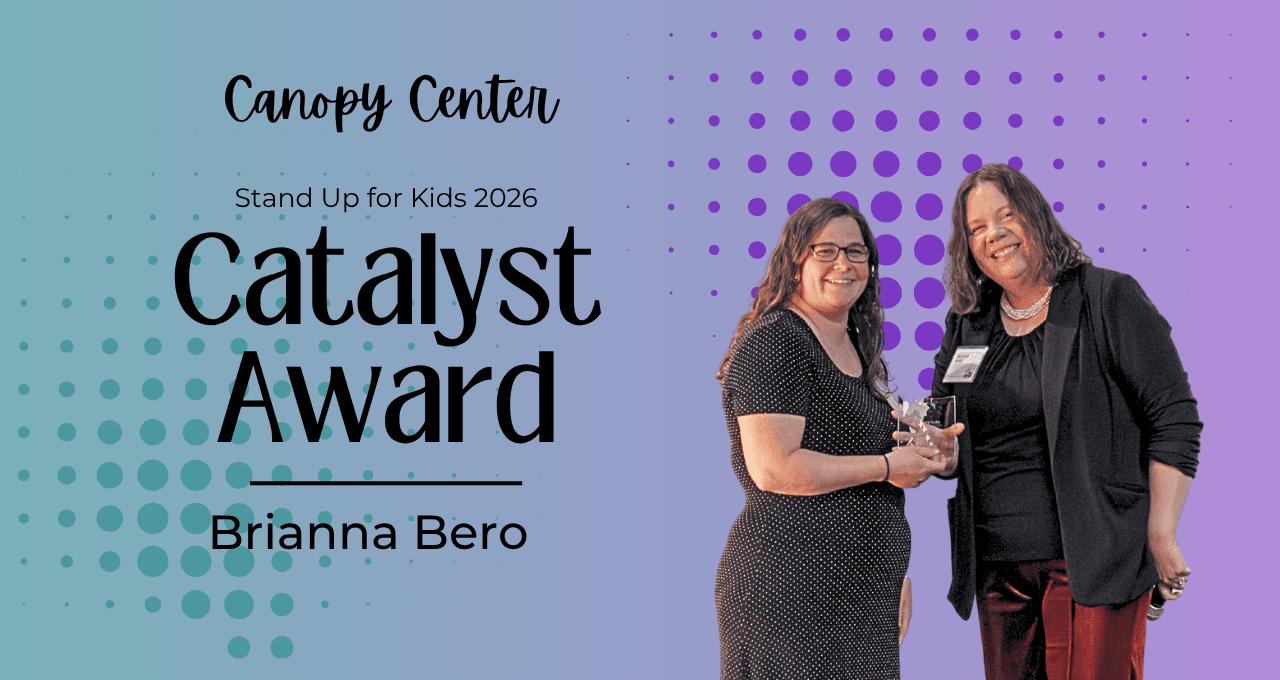
At Canopy Center, Brianna is deeply respected for her leadership and her insight. We were honored to recognize her for her contributions with a Catalyst Award at this year’s Stand Up for Kids fundraiser.
This story, Brianna’s story is not just about one teen.
It is about what happens when someone pays attention to see what others miss. When they act quickly enough to meet urgency. And when they refuse to let systems define what is possible.
It is also about what it takes to do this work well: trust, persistence, humility, and the belief that every young person deserves someone who will show up.